
Agencies are becoming AI-native. Or at least, that’s the ambition everyone’s chasing right now.
Here’s what I actually see happening in our industry, in my field, and inside my current agency: agencies are adopting AI tooling rather than changing how they work. Those are not the same thing. So I took it upon myself to make an opening move toward a genuinely AI-native workflow.
I’m a UX lead, so this piece focuses primarily on an AI-native UX workflow — but feel free to swap “UX” for any other capability. Or better yet, see how they can all work together in one model.
The default belief — and why it’s wrong
The default belief is that AI-native UX means using AI inside our current process. Better research assistants. Faster wireframes. AI-assisted QA. Everyone in the industry is chasing this version, and it feels like progress because the tools are real and the outputs are faster.
All important, yes — but it’s the wrong reframe. It treats AI as something we bolt onto a process that was designed before AI existed. And it wastes most of what AI can actually do.
Our current process was built before AI existed
Look at how most UX work still runs: Discovery (organization and research as the starting point) → Define (requirements and reports based on workshops and insights) → Design (lightly iterative, but often inside-out, with heavy stakeholder management) → Develop (delivery as the endpoint, discovery shelved).
It’s linear — discovery, design, delivery, one after the other. It’s phased — each stage ends before the next begins. And it’s held together by translation artifacts: research reports, personas, journey maps, wireframes, specs. These exist because disciplines can’t speak each other’s language directly.
Most of what UX produces today isn’t the work. It’s the translation between the work — and after go-live, the evolution stops.
The real question
Not “where does AI help?” but: what does the practice look like when AI is part of how it’s built?
AI is more than new tooling. It’s a disruptive force that requires a new workflow — not the same workflow on steroids.
The shift: from stations to substrate
From a linear process with AI added at stations, to a continuous practice with AI as the medium the whole practice runs in.
Why does the shape have to change at all? Well… a linear process has handoffs. Handoffs need translation artifacts like documents, persona maps etc and these artifacts exist because disciplines can’t speak each other’s language directly.
But if AI can hold that shared language and become the interface through which the organization maintains, challenges and uses its information, handoffs stop being predefined static objects and become accessible contextual views. And once they do, the linear shape stops being necessary. It was never the ideal shape — it was the shape that translation labor forced on us.
If handoffs don’t need translation, disciplines can work in parallel
But only if they share a common source of truth about the people a product serves. That source has to be three things:
- Alive — updating as we learn more
- Coherent — not fragmenting as it grows
- Usable — by every discipline
Those three properties are what the new model has to deliver.
AI-assisted vs. AI-native: it’s about where AI sits
AI-assisted puts AI alongside disciplines as one more capability, and its work stays bounded by whichever team invokes it — a research helper here, a design accelerator there. The linear shape survives. It’s just faster.
AI-native puts AI at the center, working on the substrate the whole practice draws from. It keeps that substrate alive, coherent, and usable — not for one team’s task, but for every discipline at once.
That’s the difference.
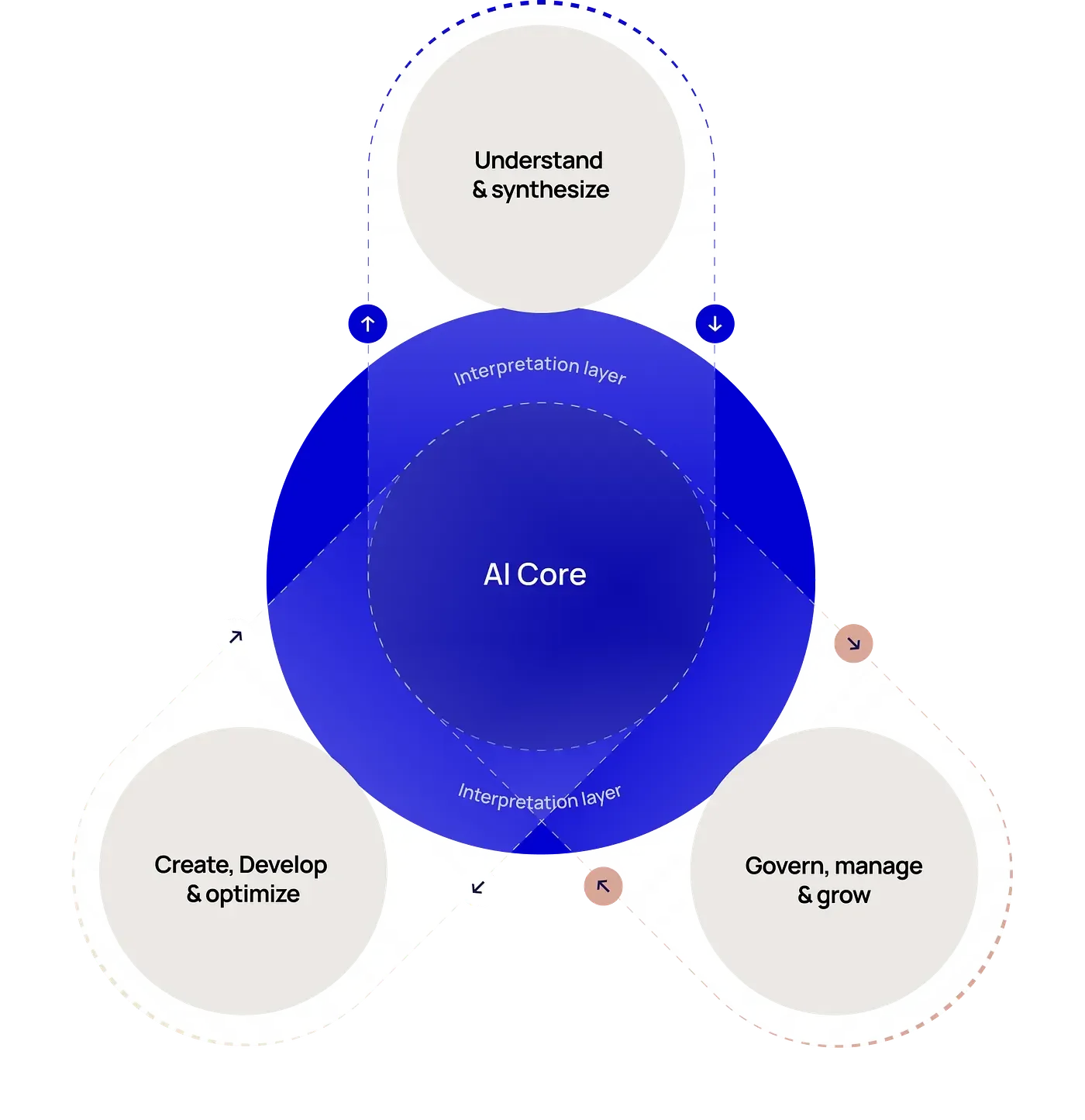
Every capability connects to the center, not to each other
In this model, research feeds the center — adding evidence, refining claims. Design consumes it — querying it to do the work. Most capabilities do both.
What they don’t do is talk directly to each other. Nothing goes discipline-to-discipline. Everything goes discipline-to-center-to-discipline. That routing is what makes the practice circular instead of linear. Obviously people can still talk to each other and they should, but the knowledge everyone holds now becomes publicly accessible and interpretable.
The center draws from five kinds of input: elicited research (interviews, usability tests, diary studies, co-design sessions), behavioral product data (analytics, session recordings, heatmaps, A/B results), voice of the customer (support tickets, chat transcripts, reviews, community mentions), business and operational context (conversion, churn, LTV, cohort retention, CRM segmentation), and institutional memory (prior research, past experiments, deprecated approaches, compliance constraints).
What the UX process could actually look like with AI at its core
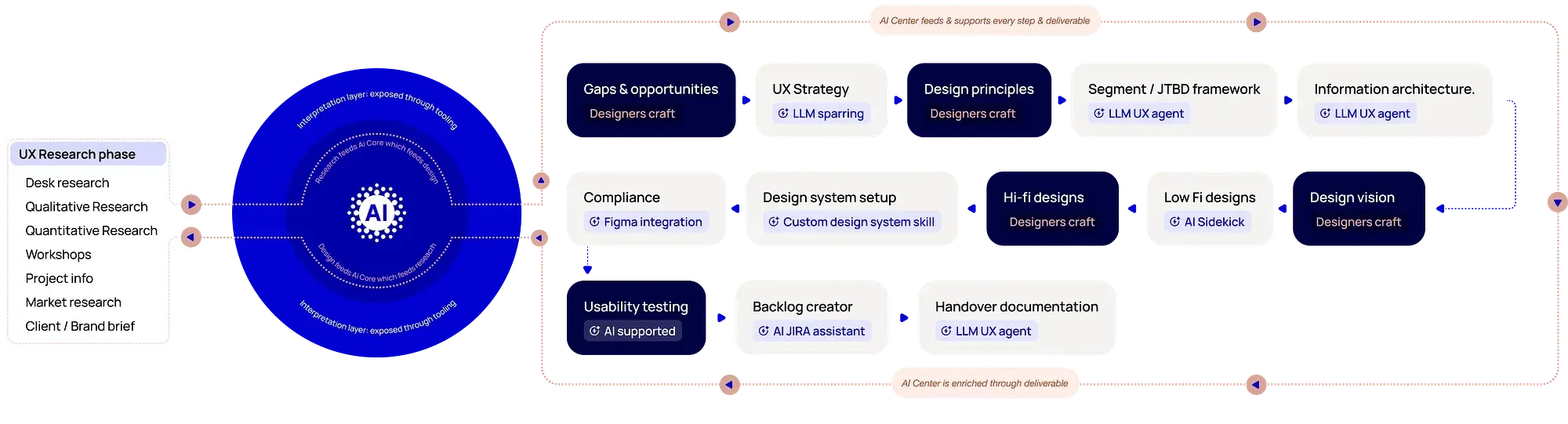
Research stops producing reports — it feeds a living center
What goes away: synthesis-as-labor, findings documents, static personas, the multi-week gap between fieldwork and something usable.
What emerges: continuous inquiry — always on, always contributing. Higher-order judgment: deciding what to investigate, designing the inquiry, validating what the practice believes. Curation as a new craft in itself.
Making the data tangible
Data is only valuable when it’s actionable and understandable. An interpretation layer translates raw data into insights that designers, stakeholders, and marketing specialists can actually use to strategize and prioritize — through tooling like situation matrices, journey views, situational profiles, top-tasks lenses, and behavior-and-cause views.
I’ve already tested this in practice: a journey map built on emotions rather than inside-out touchpoints or opinions, generating an actionable matrix that design decisions can be based on directly.
Why this matters — on four dimensions at once
Commercial. A new engagement model — the center outlives any single project, which turns governance into a recurring relationship rather than a one-off deliverable.
Competitive. A defensible methodology, not a tool stack anyone can buy. Others can adopt the same AI tools. They can’t adopt our practice.
Talent. The work shifts to where a designer’s — and every other expert’s — judgment counts: choosing, steering, deciding whether the output is good. That’s the practice experts actually want to work in.
Delivery. Higher margin, shorter cycles. Translation labor collapses — hours go to judgment work, not to artifacts nobody rereads afterward.
Yes, I’m a UX designer, but this isn’t just a UX story
This piece is UX-scoped because that’s where I have credibility. But the same structure — a living center, capabilities as orbits, AI as the medium — is how development, content, marketing, strategy, and service design can all plug in. Each discipline feeds and consumes the center in its own way, benefits from every other discipline’s insight, and avoids the “linear-with-AI-stickers” trap.
Okay — so that was my story. How do you feel about a conversation?
Also published on Medium